Author Archives: Multimedia Mike

SDL Corruption

Pursuant to Alex’s challenge to write a Unix player for Trixter’s 8088 Corruption data file, combined with an interest in re-learning the Simple DirectMedia Layer (SDL) API, I wrote a basic program that takes said data file, a font file, and the hardwired colors in the CGA card and renders the video using SDL. I don’t think the font vectors I scavenged are 100% the same as the ones in Trixter’s IBM model 5150 PC:
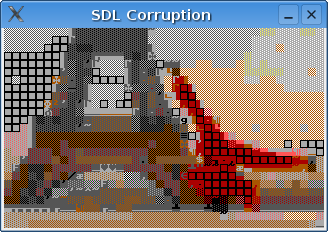

Eiffel Tower Breakdancer

In particular, I’m not sure about all of those box characters. I think the box is supposed to be one flat color. Anyway, here is another shot, only from the “Tron light cycles” section of video:
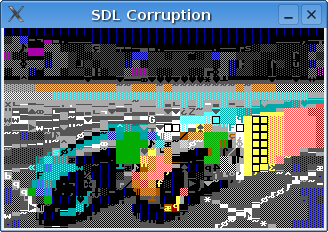

Tron Light Cycles

Followed up in SDL Corruption Corrected.
For The Uninitiated

Upon observing my ‘multimedia.cx’ domain name, someone recently inquired what kind of work I do in ‘multimedia’. I responded with a generic explanation of “digital multimedia technology” since multimedia can be kind of a broad field. When pressed to expound upon that term for the benefit of a non-technical person I responded with this:

Digital multimedia technology… you probably know that computers operate in bits– ones and zeros. 8 bits combine to make a byte. Computers store data as bits, retrieve the data as bits, and communicate with each other as bits. My field deals with taking pictures and sounds and converting them into as few bits as possible, and then turning them back into pictures and sounds again.

How’s that? How would you explain “digital multimedia technology” in the simplest terms?

SNES FMV

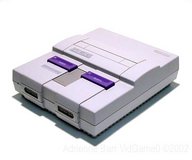
After sorting out Trixter’s 8088 Corruption details sometime ago I started to wonder about FMV on other relatively low-power systems. Let’s consider the Super Nintendo Entertainment System (SNES).


Super Nintendo Entertainment System

The SNES came out quite some time after the original IBM PC (10 years?). Still, the original IBM PC targeted in Trixter’s experiment had several advantages such as more capacity (10 megabytes of HD space), a marginally more powerful CPU (Intel 8088 @ 4.77 MHz), and a pre-defined vector codebook for the FMV hack.

Let’s start with a modest goal: 1 full minute (60 seconds) of full motion video and audio on the regulation Super Nintendo Entertainment System hardware.

Continue reading →

AVS Implementation

Thanks to Aurelien Jacobs for implementing a complete FFmpeg playback system for the AVS format. And thanks again to VAG for reverse engineering the system in the first place. It takes dedication to work on such a format that was used in one known game, Creature Shock. Well, more than one if you count the DOS, 3DO, Sega Saturn, and CD-i versions separately, and even more than that if you count the special “director’s” edition (I still need to log that one into MobyGames).

To be fair, the people behind Creature Shock went on to make a few other video games that you likely never heard of, like Alien Odyssey and FX Fighter. Both of these games contained FMV (the former being another FMV-driven game) and the formats are suspected to be influenced by AVS.