Last week brought us a lot of news in the web browser space: Mozilla released Firefox 3.6 (nice fullscreen video, BTW, especially on Linux); YouTube and Vimeo grabbed headlines by announcing HTML5 video support for their video sites.
I resolved a few months ago to not bother reading so many tech news sites since they consist of 99% misinformed drivel, and I’m a happier person for that decision. But when there’s big news that can be seen as tangentially related to what I do at my day job, it gets hard to resist.
From everything I read, there was surprisingly little Flash hatred in the wake of these announcements. Really, the situation just erupted into an all-out war between the devotees of Firefox (and to a lesser extent, Opera) and supporters of Google (and to a lesser extent Apple and their Safari browser). It gets boring and repetitive in a hurry when you start reading these discussions since they all go something like this:
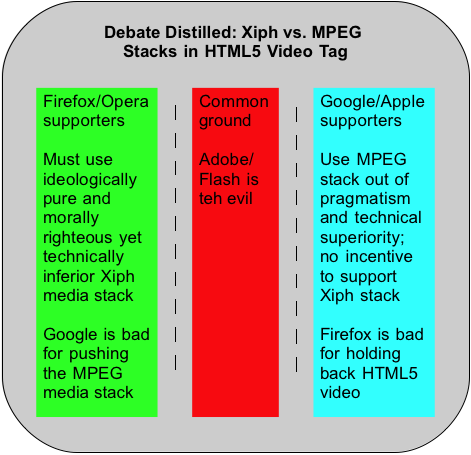
As you can see from the infographic, at least both sides can agree on something. I would also like to state my emphatic support for Mozilla’s principled, hardline stance against the MPEG stack for HTML5 video. Please don’t budge on your position. Stand firm on the moral high ground.
That graphic is just the beginning; there are so many problems with HTML5 video that it’s hard to know where to even begin. That’s why I need to remember to just laugh gently at its mention and move along. I only get a headache trying to understand how HTML5 video could ever have the slightest chance of mattering in the grand scheme of things.
However, a pleasant side effect of this attention is that more and more people are actually being exposed to the video tag. One nagging detail people invariably notice is that the video tag performs exceptionally poorly, likely because browsers have to deal with the exact same limitations that the Flash Player does, namely, converting decoded YUV data to RGB so that it can be plopped on a browser page. And if you try to claim that you can just download the media and use a standalone player, you continue to miss the entire point of web video.
Another aspect I have to appreciate about the debate surrounding HTML5 video is the way that it brings out the positive spirit in people. Online discussions are normally overwhelmingly negative. But advocates of the HTML5/Xiph approach truly believe this could all work out: If Apple decides to adopt the Xiph stack, and if some benevolent hardware company would churn out custom ASICs for decoding Xiph codecs, and if those ASICs were adopted in next quarter’s array of mobile computing devices and netbooks, and if Google transcodes their zillobytes of YouTube videos to the Xiph stack, and if Google throws the switch and forces the 60% of IE-using stragglers to either change browsers or go without YouTube, and if Google thereby forgoes many opportunities to monetize their videos, then absolutely! HTML5 video could totally unseat Flash video.
Okay, that’s it for me. I’m going to go back to ignoring the insular, elitist tech world at large except for the few domains in which I have some influence.
See Also: