The MOOBEX project was really the first real exposure I had to the Amarok application. For the uninitiated, Amarok is a rather full-featured KDE-based music playing application and has been around since 2003. Back when I used Linux more exclusively, I stuck to xine directly for all of my media playback needs.
How was my first impression of Amarok? Well… it’s hard to say. The program was different on each distribution that I tried. In OpenSUSE, I was thoroughly frustrated when I first tried to play a file through Amarok, or rather, when I selected an audio file through the file manager and just let the system do its thing. Amarok popped up and just sort of stared at me. Okay, I recognize that I’m throwing a bunch of formats toward Amarok that the distro has administratively determined to be “legally unsafe”. But I should still get some obvious feedback to that effect. Oh, wait, look way down there in the status bar:
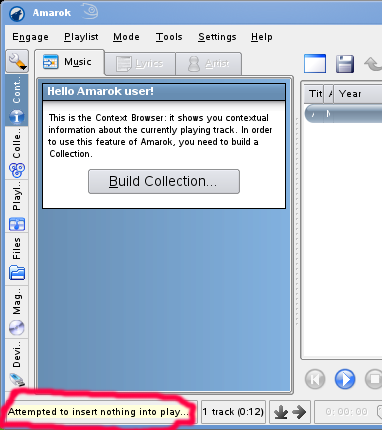
When I launched an audio file on another KDE-based distro installation (Mandriva), I expected the same behavior from Amarok. To my surprise, the program threw a far more brazen error. Ubuntu has Amarok version 1.4.9.1. Mandriva sports 1.4.8. The Amarok version in Mandriva exhibited the superior UI characteristic. I understand the source of the unsupported codecs. But I wonder about the dialog discrepancy. I am not sure if this dialog behavior is a version specific thing in Amarok, or a configuration option in Amarok, or an dialog characterstic configurable in the hosting KDE libraries. It’s a minor matter, to be sure, but it still makes me wonder how individual distributions would be able to devalue something like the Adobe Flash Player if it were open source and allowed distros to make “choice” changes to the functionality.
I’m sure that the Amarok developers worked very hard to produce the best music player they could. And it probably hurts to see their fruits of their labor mangled by various distributions to the point of practical worthlessness. I know the feeling based on my work on xine.
But here’s a huge annoyance with Amarok which I suspect is a core behavior: stop should mean STOP! When I did get a file to play and then tried to stop playback, the audio kept right on going long enough to make me think that something was wrong. Eventually, the audio started to gently fade out. This is not reasonable behavior. The expected action for a stop button is an immediate halt.