I have just activated 18 new test specs for FATE. One is a test for one variant of the newly supported DPX format. The other 17 are for various samples in the fidelity range extension suite of test vectors, an extension of H.264 that FFmpeg has supported for some time. It should be noted that more samples from this suite should be forthcoming as soon as I finish downloading the whole thing (something I thought I had done a long time ago).
Author Archives: Multimedia Mike
Perceptual Video Testing
While I have thought a lot about the problem of testing perceptual audio decoders in FFmpeg via FATE, I have put little thought into testing perceptual video decoders. I surmise that my 1-off testing method for perceptual audio decoders is probably not tractable for video decoders. I suspect that, while rounding errors also cause off-by-1 errors in video decoders, compounded errors during multiple frames could stretch the threshold. There’s also the minor matter that it would require a much larger amount of space to store raw video data vs. the audio data required for the perceptual audio tests.
Testing video decoders isn’t such a big deal, though. The FFmpeg devs have had this problem solved via the ‘make test’ regression suite for a long time. There are a few flags to tack onto a command line which will invoke a bit exact inverse discrete cosine transform (IDCT). The trade-off is that optimized IDCT code paths are not exercised.
I’m thinking of a 2-part solution:
- As a first pass, enter video decoding tests that leverage the bit exact IDCT.
- As a second pass, craft special test cases that decode one frame of video and leverage the default, optimized IDCT. Test the result using the 1-off method.
See Also:
Terminator Salvation Credit Code Snippets
I saw Terminator Salvation recently. Observers enjoy dissecting the many ways that the entire Terminator franchise fails to add up, logically. I’m certainly not here to defend it.

When facing scary-looking creatures like spiders, loud dogs, and humanoid robots, it helps to remember that they’re probably more afraid of you than you are of them. Probably.
However, none of the reviews or analyses I have read so far have mentioned the opening credit sequence for Salvation. Every actor’s name is ensconsed in some nonsensical computer code construct. The average programmer finds himself unable to avoid guessing what language the movie could have been hinting at– C, C++, Objective-C, XML, Python. They looked something like this:
/**Christian Bale;

>> Sam Worthington <
>

[ Helena Bonham Carter ]

Moon Bloodgood++

<Anton> <Yelchin>
I’m surprised that this hasn’t merited a mention in IMDb’s Crazy Credits section for the movie. Maybe Skynet (the master computer of the Terminator franchise) uses a proprietary language which is a mish-mash of all the computer languages the humans developed.
Madcow In FFmpeg
Suxel Drol continues his relentless quest to add all Electronics Arts multimedia formats to FFmpeg. The most recent fruit of this labor is the Madcow video decoder.
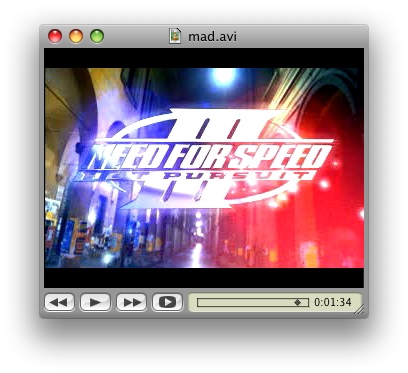
The test spec is ready to go, as is another test spec for a new demuxer named QCP.
Speaking of that QCP format, that comes courtesy of Dark Shikari, toiling away at his new gig over at Facebook. Facebook, he informs us, might just be the largest user of FFmpeg. They have quite a few members uploading random multimedia files which presents just as formidable a challenge as Picsearch. QCP is just one of the (formerly) unknown formats encountered.
Oh, and I also found a way to fix that pva-demux test that has been failing for over a week. We should have a greener baseline now.