Yearly Archives: 2006

V.Flash

I briefly spied a television commercial for a product called the V.Flash by VTech. The sound was off, but I got the impression that it was some kind of new game console for young children. And it appeared to have pretty decent graphical capabilities which is somewhat unexpected in this market.
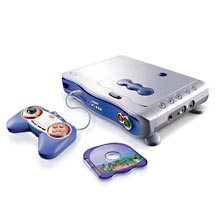

VTech's V.Flash

Based on Google searches thus far, there doesn’t seem to be a big underground/hacking/homebrew scene developing around this new console yet. So it’s difficult to find hard technical data about it. Whatever the guts are made of, it must be possible to sell them at US$100 per unit and presumably make a profit. The 3D graphics aren’t especially revolutionary, but who can tell the difference in this day and age? In fact, based on screenshots and web videos I have seen thus far, the graphic quality strikes me as reminiscent of the PlayStation-N64 days. Further, the unit only supports composite A/V output.

Here is the PDF manual for the V.Flash console. As you can see from the above marketing photo, the system uses optical media in a cartridge, which is affectionately termed a V.DiscTM. The manual describes that the console comes with a tray onto which a user can mount an audio CD (and apparently a photo CD). This implies that the unit has the optical hardware to read CDs. I think it’s reasonable that it does not also read DVDs or else they would probably be able to advertise DVD playback capability. Plus, DVD playback ability would markedly increase costs via parts and technology licensing costs.

Naturally, I’m interested to see if the CDs have any FMV. The games are apparently widespread wherever fine toys are sold. They are around US$30 each and the company has managed to publish an impressive line-up of licensed titles featuring such properties as Spider-Man, Spongebob Squarepants, and Disney Princesses. It seems reasonable that one of these discs could be separated from its cartridge relatively easily and read in a normal PC’s optical drive.

What’s the wager that the unit contains, at its heart, an x86_32-type CPU? Then again, the V.Flash comes from a company that is hardly a startup and appears to have years of experience making small, game-related devices.

Those Who Can, Do

The conventional adage has held that “Those who can, do; those who can’t, teach.” I’ve recently observed some alternative vocations for those who can’t. For example, “Those who can, do; those who can’t, carry out sociological studies on those who can in some effort to gain insight into what motivates them to do what they do.” Not especially catchy, but there it is.

If you participate in any open source software development, or even just hang out on development mailing lists, you have probably seen emails from university grad students performing some survey of open source developers. I’ve been doing this free software programming stuff since 1999. I don’t remember exactly when I first saw one of these email solicitations to fill out a survey but I do remember that I thought it novel at the time and cheerfully contributed. Same with the next half dozen or so. Eventually, I started getting that “haven’t I seen this before?” feeling when encountering such survey solicitations. This notion is exacerbated by the fact that each survey seems to think that it’s breaking new ground.

The only reason I bring this up is that I got another survey solicitation today in private email. This email was particularly irksome in that it was actually a followup to an earlier solicitation that demanded to know why I had not responded to the earlier inquiry.

As I compose this post, it suddenly occurs to me to wonder why anyone would care about collating this type of data (aside from a researcher attempting to justify his academic existence and delaying the real world activities as long as possible). This latest survey comes from people in some business and management schools. I can’t shake the feeling that there might be some businesses out there who would be interested to know what motivates open source software development in an effort to better leverage the model for their own business objectives.

PS3 First Impressions

HardwareZone has an article about running Fedore Core Linux on the PS3. They’re not terribly impressed yet, though they reserve some hope that the official Yellow Dog Linux distro might somehow be better. A big problem is graphics resolution– you’re confined to a fairly negligible screen size if you don’t have both the right TV and the right connector cable (a problem that a colleague of mine has also encountered while venturing into this arena). And without any form of hardware acceleration, the overall desktop presentation is apparently unremarkable. Check the photos of OpenOffice running on the TV.

I’m still hopeful that PS3 Linux can be put to some use, just as soon as people get past the novelty of running a web browser and a word processor on an unaccelerated graphic display through their TV.

Groupie

I’m turning into a PS3 Linux groupie, salivating over any technical information I can find. Sony has, in fact, released some programming details regarding their new PlayStation 3. In particular, the documents discuss what a user can do under Linux (more generally, “Other OS”). I’m not sure where the official documents are supposed to live. There are ostensibly various document mirrors floating around, so here’s one more.

Let’s examine the Linux Kernel Overview document, which reveals the basic capabilities that a user can expect. Perhaps the most obnoxious — though not wholly unexpected — aspect is when the document explains the console’s phenomenal audio and video capabilities… and promptly notes that you will not be able to access a fraction of the power. For example:

PS3 has a powerful graphic processing unit with high speed host connection. The GPU is connected to both HDMI and AV multi interface. Although the GPU is connected directly to CBE, no direct access by guest OSes to the GPU is allowed currently.

So the graphic capability is limited to a big frame buffer. Hopefully, it can go up to 1080p. For audio, it’s unclear how many channels the PS3 will allow the guest OS to access. I will be impressed if the number is greater than 2 (stereo).

Gigabit network access is allowed, sans promiscuous mode. Believe it or not, access to the optical drive is allowed. The overview document specifically states that the drive will reject certain ATAPI commands which is likely in place to prevent the user reading data from discs that have been determined to be official PlayStation 1/2/3 games. HDD and USB storage devices can be accessed, though the PS3 hypervisor probably enforces segmentation to keep the guest OS from going out of bounds on the HDD.

The game pad can be accessed, thankfully, through standard joystick facilities. I don’t think the hypervisor will be sandboxing anything in that department.

Perhaps the most interesting part of these still-incomplete documents is the PDF describing IBM’s libspe. This indicates that the guest OS will be able to program the 6 Cell SPEs present in the PS3. This makes me wonder if the much-vaunted parallel processing power of the Cell made available to the guest OS might be able to compensate for the lack of graphic coprocessing power. I’m not sure about this yet; I’m still trying to digest the SPE documentation.