Yearly Archives: 2006

Early Adopter

The IMDb Studio Briefing reported today that “HD DVD To Debut Today”. So I ran over to Best Buy and picked one up. Seriously. Here it is:
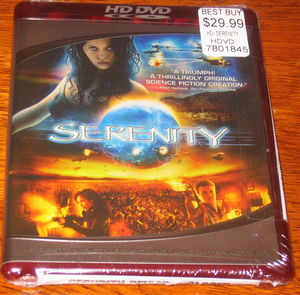

Serenity HD-DVD

No, I don’t have a player yet. That never stopped me from buying PlayStation or Xbox games just for studying the multimedia (that was different because I still have computer hardware that can read the raw sectors). Best Buy also had players available but I do not intend to get any hardware until an HD-DVD ROM drive becomes available. Ah, the burden of early adoption.

Best Buy had the HD-DVD material in the high-end home theater department. I asked if they had any HD-DVDs in yet. The employee said the titles were behind the counter but then eyed me suspiciously and asked if I was from Toshiba. I’m not sure what that exchange was about but after I assured him that I was sincerely interested in a purchase he brought out the 3 launch titles– Serenity, The Phantom of the Opera, and The Last Samurai. I certainly wasn’t the only early adopter. At this same time, there were other customers entering the same department asking for the HD-DVD player and all 3 launch titles. Take another look at those 3 launch titles. Do you think that anyone would actually like all 3 of those movies? My guess is that these people were really interested in the purchase simply for the sake of having the latest technology.

Their demo HD-DVD players were doing duty with some sort of demo material with a split screen that contrasted high definition vs. standard definition. The demo struck me as — what’s the word — bogus. Come on– standard definition can’t possibly look that bad. Can you say “blur filter”?

Click [more] to see scans of everything in the case so you know what the next generation looks like.

Continue reading

Feeble Files DXA And Wiki Upgrade

Kirben from ScummVM tipped me off on the DXA format. Apparently, it was only ever used in one game called Feeble Files. He reports that the Amiga and Macintosh ports used the DXA format. I was unaware that there were any commercial games for the Amiga past about 1995. Here is the requisite Wiki page on the format. It’s one of the simplest formats yet. It’s unusual in that it stores all of the audio data in a single WAV file chunk near the start. The known video coding format simply uses zlib’s deflate() function to compress a raw frame or the result of a XOR operation between the current and previous frames.

Speaking of the Wiki, I have upgraded the MultimediaWiki to the latest, and therefore greatest, incarnation of MediaWiki — 1.6.3. I don’t see too many major differences so far. There are supposed to be some useful counter-spam features which seems to be increasingly important. I still can’t generate math expressions in Wiki. I’ve traced this to the absence of LaTeX processing utilities on the host machine. Why does LaTeX always have to cause such trouble? We’re stuck with plaintext math expressions until I can get around this problem somehow.

Doxygen As RE Tool

It’s important not to overlook some obvious tools even though they may not be chartered for reverse engineering purposes. Think of Doxygen. This is that tool that can look at your project full of source code and extract all of the comments and data structures and functions and automatically generate a cleanly interlinked set of HTML files to browse.

Doxygen logo

It helps if you design a project from the ground up to take advantage of Doxygen’s features. But strictly speaking, Doxygen doesn’t really care how poorly a project is commented. It will still plow through the source code, analyzing it as best it can.

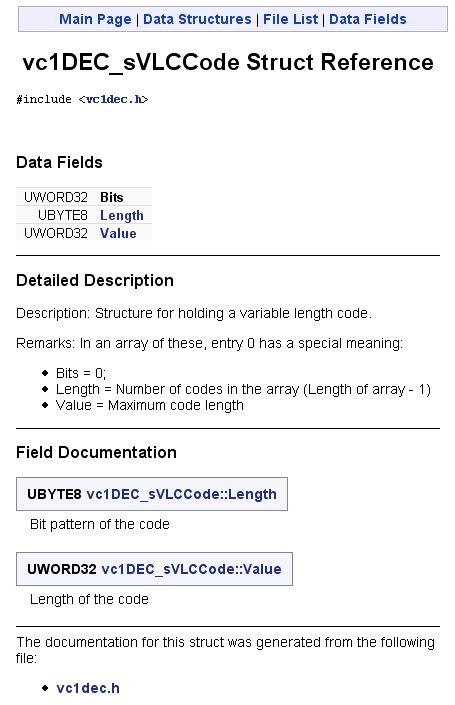
I am still working diligently on Understanding VC-1. Now, the SMPTE reference decoder is quite neatly documented. However, in trying to understand functions there is the inevitable jumping back and forth between source files trying to figure out what this or that data structure contains. In this, Doxygen relieves some of the RE pain. As a small example, here is what the Doxygen-generated HTML for the VLC data structure looks like (it’s a picture; don’t bother to click the links):


Doxygen example

This example turned out all right. Sometimes, however, the comments don’t match up with the fields since they weren’t formatted with Doxygen in mind. On average, it’s still an improvement than the standard file-hopping.

Moving Objects Video Codec

Breathless stories of new movie downloading servies are all too common on the IMDb Studio Briefing. However, this story stands out due to the claims it makes regarding fundamental video codec technology: Coming Soon: Instant Movie Downloads.

Euclid Discoveries…claims to have developed a technology that can compress a feature film into a file so small that it can be downloaded over the Internet in five minutes. …the system employs “object-based compression” that remembers recurring objects and stores them in memory. …a movie requiring 700 megabytes of storage with the established MPEG-4 compression technology uses just 50 megabytes under the new one.

FMV built using a series of moving objects is, of course, nothing new. In fact, that’s how video animation was performed in video games well before enough capacity was available to feasibly transport frames of compressed video. I know of several video codecs that contain provisions for moving sprites around the video field, including Duck TrueMotion 1 and ISO MPEG-4 (which makes it especially ironic that they should specifically mention the latter in the article). I imagine that both of those technologies were developed as vehicles to deliver video that was developed as layers of sprites on backgrounds. The challenging problem is to examine existing video and find discrete objects that move around from frame to frame.

Continue reading