Metal Gear Solid VP3 Easter Egg

Metal Gear Solid: The Twin Snakes for the Nintendo GameCube is very heavy on the cutscenes. Most of them are animated in real-time but there are a bunch of clips — normally of a more photo-realistic nature — that the developers needed to compress using a conventional video codec. What did they decide to use for this task? On2 VP3 (forerunner of Theora) in a custom transport format. This is only the second game I have seen in the wild that uses pure On2 VP3 (first was a horse game). Reimar and I sorted out most of the details sometime ago. I sat down today and wrote a FFmpeg / Libav demuxer for the format, mostly to prove to myself that I still could.

Things went pretty smoothly. We suspected that there was an integer field that indicated the frame rate, but 18 fps is a bit strange. I kept fixating on a header field that read 0x41F00000. Where have I seen that number before? Oh, of course — it’s the number 30.0 expressed as an IEEE 32-bit float. The 4XM format pulled the same trick.

Hexadecimal Easter Egg
I know I finished the game years ago but I really can’t recall any of the clips present in the samples directory. The file mgs1-60.vp3 contains a computer screen granting the player access and illustrates this with a hexdump. It looks something like this:
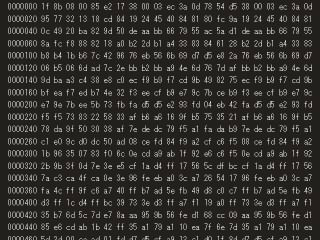


Funny, there are only 22 bytes on a line when there should be 32 according to the offsets. But, leave it to me to try to figure out what the file type is, regardless. I squinted and copied the first 22 bytes into a file:

 1F 8B 08 00   85 E2 17 38   00 03 EC 3A   0D 78 54 D5
 38 00 03 EC   3A 0D 

And the answer to the big question:

$ file mgsfile
mgsfile: gzip compressed data, from Unix, last modified: Wed Oct 27 22:43:33 1999

A gzip’d file from 1999. I don’t know why I find this stuff so interesting, but I do. I guess it’s no more and less strange than writing playback systems like this.
Ode to the Gravis Ultrasound

WARNING: This post is a bunch of nostalgia. Feel free to follow along if you recall the DOS days of the early-mid 1990s.

Also, if you’re interested in the Gravis Ultrasound Experience CD-ROM, you can download the compressed ISO image here (137 megabytes). This only contains the data track as a .ISO file. However, the Internet Archive hosts the disc in CUE/BIN format which includes all the data tracks.

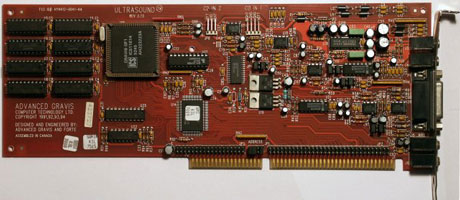
I finally let go of my Gravis Ultrasound MAX sound card a little while ago. It felt like the end of an era for me, even though I had scarcely used the card in recent memory.


The Beginning
What is the Gravis Ultrasound? Only the finest PC sound card from the classic DOS days. Back in the day (very early 1990s), most consumer PC sound cards were Yamaha OPL FM synthesizers paired with a basic digital to analog converter (DAC). Gravis, a company known for game controllers, dared to break with the dominant paradigm of Sound Blaster clones and create a sound card that had 32 digital channels.
Continue reading

Multimedia Exploration Journal: The Past Doesn’t Die

New haul of games, new (old) multimedia formats.

Lords of Midnight
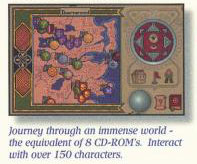
Check out the box copy scan for Lords of Midnight in MobyGames. In particular, I’d like to call your attention to this little blurb:


Ahem, “Journey through an immense world — the equivalent of 8 CD-ROMs.” Yet, when I procured the game, it only came on a single CD-ROM. It’s definitely a CD-ROM (says so on the disc) and, coming from 1995, certainly predates the earliest DVD-ROMs (which can easily store 8 CD-ROMs on a disc). Thus, I wanted to jump in a see if they were using some phenomenal compression in order to squeeze so much info into 600 or so megabytes.

I was surprised to see the contents of the disc clocking in at just under 40 megabytes. An intro movie and an outro movie account for 75% of that. Format? None other than that curious ASCII anomaly, ARMovie/RPL with Escape 122 codec data.

Cyclemania


Cyclemania is one of those FMV backdrop action games, but with a motorcycle theme. I had a good feeling I would find some odd multimedia artifacts here and the game didn’t disappoint. The videos are apparently handled using 3-4 discrete files per animation. I’ve documented my cursory guesses and linked some samples at the new MultimediaWiki page.

Interplay ACMP
This is unrelated to this particular acquistion, but I was contacted today about audio files harvested from the 1993 DOS game Star Trek: Judgment Rites. The files begin with the ASCII signature “Interplay ACMP Data”. This reminds me of Interplay MVE files which begin with the similar string “Interplay MVE File”. My theory is that these files use the ACOMP compression format, though I’m still trying to make it fit.

Wiki and samples are available as usual if you’d like to add your own research.

PC Video Conferencing in the Year 1999

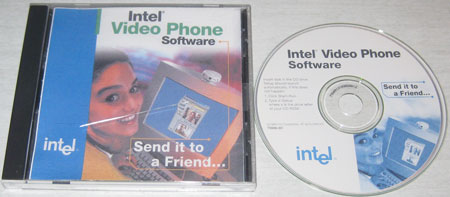
Remember Intel’s custom flavor of H.263 cleverly named I.263? I think I have finally found an application that used it thanks to a recent thrift shop raid— Intel Video Phone:


The root directory of the disc has 2 copies of an intro.avi video. One copy uses Intel Indeo 3 video and PCM audio. The other uses I.263 video and an undetermined (presumably Intel-proprietary) audio codec — RIFF id 0x0402 at a bitrate of 88 kbits/sec for stereo, 22 kHz audio. The latter video looks awful but is significantly smaller (like 4 MB vs. 25 MB).

This is the disc marked as “Send it to a friend…”. Here’s the way this concept was supposed to operate:

  • You buy an Intel Video Phone Camera Pack (forgotten page courtesy of the Internet Archive) which includes a camera and 2 CDs.
  • You install the camera and video phone software on your computer.
  • You send the other CD to the person whom you want to be able to see your face when you’re teleconferencing with them.
  • The other party installs the software.
  • The 2 of you may make an internet phone call presumably using commodity PC microphones for the voice component; the person who doesn’t have a camera is able to see the person who does have a camera.
  • In a cunning viral/network marketing strategy, Intel encourages the other party to buy the physical hardware as well so that they may broadcast their own visage back to the other person.

If you need further explanation, the intro lady does a great job:


I suspect I.263 was the video codec driving this since Indeo 3 would probably be inappropriate for real time video applications due to its vector quantizing algorithm.