Adjusting The Timetable and SQL Shame

My Game Music Appreciation website has a big problem that many visitors quickly notice and comment upon. The problem looks like this:
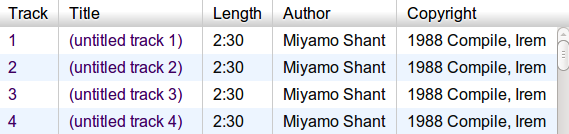


The problem is that all of these songs are 2m30s in length. During the initial import process, unless a chiptune file already had curated length metadata attached, my metadata utility emitted a default play length of 150 seconds. This is not good if you want to listen to all the songs in a soundtrack without interacting with the player page, but have various short songs (think “game over” or other quick jingles) that are over in a few seconds. Such songs still pad out 150 seconds of silence.

So I needed to correct this. Possible solutions:

  1. Manually: At first, I figured I could ask the database which songs needed fixing and listen to them to determine the proper lengths. Then I realized that there were well over 1400 games affected by this problem. This just screams “automated solution”.
  2. Automatically: Ask the database which songs need fixing and then somehow ask the computer to listen to the songs and decide their proper lengths. This sounds like a winner, provided that I can figure out how to programmatically determine if a song has “finished”.

SQL Shame
This play adjustment task has been on my plate for a long time. A key factor that has blocked me is that I couldn’t figure out a single SQL query to feed to the SQLite database underlying the site which would give me all the songs I needed. To be clear, it was very simple and obvious to me how to write a program that would query the database in phases to get all the information. However, I felt that it would be impure to proceed with the task unless I could figure out one giant query to get all the information.

This always seems to come up whenever I start interacting with a database in any serious way. I call it SQL shame. This task got some traction when I got over this nagging doubt and told myself that there’s nothing wrong with the multi-step query program if it solves the problem at hand.

Suddenly, I had a flash of inspiration about why the so-called NoSQL movement exists. Maybe there are a lot more people who don’t like trying to derive such long queries and are happy to allow other languages to pick up the slack.

Estimating Lengths
Anyway, my solution involved writing a Python script to iterate through all the games whose metadata was output by a certain engine (the one that makes the default play length 150 seconds). For each of those games, the script queries the song table and determines if each song is exactly 150 seconds. If it is, then go to work trying to estimate the true length.

The forgoing paragraph describes what I figured was possible with only a single (possibly large) SQL query.

For each song represented in the chiptune file, I ran it through a custom length estimator program. My brilliant (err, naïve) solution to the length estimation problem was to synthesize seconds of audio up to a maximum of 120 seconds (tightening up the default length just a bit) and counting how many of those seconds had all 0 samples. If the count reached 5 consecutive seconds of silence, then the estimator rewound the running length by 5 seconds and declared that to be the proper length. Update the database.

There were about 1430 chiptune files whose songs needed updates. Some files had 1 single song. Some files had over 100. When I let the script run, it took nearly 65 minutes to process all the files. That was a single-threaded solution, of course. Even though I already had the data I needed, I wanted to try to hand at parallelizing the script. So I went to work with Python’s multiprocessing module and quickly refactored it to use all 4 CPU threads on the machine where the files live. Results:

  • Single-threaded solution: 64m42s to process corpus (22 games/minute)
  • Multi-threaded solution: 18m48s with 4 CPU threads (75 games/minute)

More than a 3x speedup across 4 CPU threads, which is decent for a primarily CPU-bound operation.

Epilogue
I suspect that this task will require some refinement or manual intervention. Maybe there are songs which actually have more than 5 legitimate seconds of silence. Also, I entertained the possibility that some songs would generate very low amplitude noise rather than being perfectly silent. In that case, I could refine the script to stipulate that amplitudes below a certain threshold count as 0. Fortunately, I marked which games were modified by this method, so I can run a new script as necessary.

SQL Schema
Here is the schema of my SQlite3 database, for those who want to try their hand at a proper query. I am confident that it’s possible; I just didn’t have the patience to work it out. The task is to retrieve all the rows from the games table where all of the corresponding songs in the songs table is 150000 milliseconds.
Continue reading

Adding A New System To The Game Music Website

At first, I was planning to just make a little website where users could install a Chrome browser extension and play music from old 8-bit NES games. But, like many software projects, the goal sort of ballooned. I created a website where users can easily play old video game music. It doesn’t cover too many systems yet, but I have had individual requests to add just about every system you can think of.

The craziest part is that I know it’s possible to represent most of the systems. Eventually, it would be great to reach Chipamp parity (a combination plugin for Winamp that packages together plugins for many of these chiptunes). But there is a process to all of this. I have taken to defining a number of phases that are required to get a new system covered.

Phase 0 informally involves marveling at the obscurity of some of the console systems for which chiptune collections have evolved. WonderSwan? Sharp X68000? PC-88? I may be viewing this through a terribly Ameri-centric lens. I’ve at least heard of the ZX Spectrum and the Amstrad CPC even if I’ve never seen either.

No matter. The goal is to get all their chiptunes cataloged and playable.

Phase 1: Finding A Player
The first step is to find a bit of open source code that can play a particular format. If it’s a library that can handle many formats, like Game Music Emu or Audio Overload SDK, even better (probably). The specific open source license isn’t a big concern for me. I’m almost certain that some of the libraries that SaltyGME currently mixes are somehow incompatible, license-wise. I’ll worry about it when I encounter someone who A) cares, and B) is in a position to do something about it. Historical preservation comes first, and these software libraries aren’t getting any younger (I’m finding some that haven’t been touched in a decade).

Phase 2: Test Program
The next phase is to create a basic test bench program that sends a music file into the library, generates a buffer of audio, and shoves it out to the speakers via PulseAudio’s simple API (people like to rip on PulseAudio, but its simple API really lives up to its name and requires pages less boilerplate code to play a few samples than ALSA).

Phase 3: Plug Into Web Player
After successfully creating the test bench and understanding exactly which source files need to be built, the next phase is to hook it up to the main SaltyGME program via the ad-hoc plugin API I developed. This API requires that a player backend can, at the very least, initialize itself based on a buffer of bytes and generate audio samples into an array of 16-bit numbers. The API also provides functions for managing files with multiple tracks and toggling individual voices/channels if the library supports such a feature. Having the test bench application written beforehand usually smooths out this step.

But really, I’m just getting started.

Phase 4: Collecting A Song Corpus
Then there is the matter of staging a collection of songs for a given system. It seems like it would just be a matter of finding a large collection of songs for a given format, downloading them in bulk, and mirroring them. Honestly, that’s the easy part. People who are interested in this stuff have been lovingly curating massive collections of these songs for years (see SNESmusic.org for one of the best examples, and they also host a torrent of all their music for really quick and easy hoarding).
Continue reading

Re-solving My Search Engine Problem

14 years ago, I created a web database of 8-bit Nintendo Entertainment System games. To make it useful, I developed a very primitive search feature.

A few months ago, I decided to create a web database of video game music. To make it useful, I knew it would need to have a search feature. I realized I needed to solve the exact same problem again.

Requirements
The last time I solved this problem, I came up with an excruciatingly naïve idea. Hey, it worked. I really didn’t want to deploy the same solution again because it felt so silly the first time. Surely there are many better ways to solve it now? Many different workable software solutions that do all the hard work for me?

The first time I attacked this, it was 1998 and hosting resources were scarce. On my primary web host I was able to put static HTML pages, perhaps with server side includes. The web host also offered dynamic scripting capabilities via something called htmlscript (a.k.a. MIVA Script). I had a secondary web host in my ISP which allowed me to host conventional CGI scripts on a Unix host, so that’s where I hosted the search function (Perl CGI script accessing a key/value data store file).

Nowadays, sky’s the limit. Any type of technology you want to deploy should be tractable. Still, a key requirement was that I didn’t want to pay for additional hosting resources for this silly little side project. That leaves me with options that my current shared web hosting plan allows, which includes such advanced features as PHP, Perl and Python scripts. I can also access MySQL.

Candidates
There are a lot of mature software packages out there which can index and search data and be plugged into a website. But a lot of them would be unworkable on my web hosting plan due to language or library package limitations. Further, a lot of them feel like overkill. At the most basic level, all I really want to do is map a series of video game titles to URLs in a website.

Based on my research, Lucene seems to hold a fair amount of mindshare as an open source indexing and search solution. But I was unsure of my ability to run it on my hosting plan. I think MySQL does some kind of full text search, so I could have probably made a solution around that. Again, it just feels like way more power than I need for this project.

I used Swish-e once about 3 years ago for a little project. I wasn’t confident of my ability to run that on my server either. It has a Perl API but it requires custom modules.

My quest for a search solution grew deep enough that I started perusing a textbook on information retrieval techniques in preparation for possibly writing my own solution from scratch. However, in doing so, I figured out how I might subvert an existing solution to do what I want.

Back to Swish-e
Again, all I wanted to do was pull data out of a database and map that data to a URL in a website. Reading the Swish-e documentation, I learned that the software supports a mode specifically tailored for this. Rather than asking Swish-e to index a series of document files living on disk, you can specify a script for Swish-e to run and the script will generate what appears to be a set of phantom documents for Swish-e to index.
Continue reading

Zlib vs. XZ on 2SF

I recently released my Game Music Appreciation website. It allows users to play an enormous range of video game music directly in their browsers. To do this, the site has to host the music. And since I’m a compression bore, I have to know how small I can practically make these music files. I already published the results of my effort to see if XZ could beat RAR (RAR won, but only slightly, and I still went with XZ for the project) on the corpus of Super Nintendo chiptune sets. Next is the corpus of Nintendo DS chiptunes.

Repacking Nintendo DS 2SF
The prevailing chiptune format for storing Nintendo DS songs is the .2sf format. This is a subtype of the Portable Sound Format (PSF). The designers had the foresight to build compression directly into the format. Much of payload data in a PSF file is compressed with zlib. Since I already incorporated Embedded XZ into the player project, I decided to try repacking the PSF payload data from zlib -> xz.

In an effort to not corrupt standards too much, I changed the ‘PSF’ file signature (seen in the first 3 bytes of a file) to ‘psf’.

Results
There are about 900 Nintendo DS games currently represented in my website’s archive. Total size of the original PSF archive, payloads packed with zlib: 2.992 GB. Total size of the same archive with payloads packed as xz: 2.059 GB.

Using xz vs. zlib saved me nearly a gigabyte of storage. That extra storage doesn’t really impact my hosting plan very much (I have 1/2 TB, which is why I’m so nonchalant about hosting the massive MPlayer Samples Archive). However, smaller individual files translates to a better user experience since the files are faster to download.

Here is a pretty picture to illustrate the space savings:


The blue occasionally appears to dip below the orange but the data indicates that xz is always more efficient than zlib. Here’s the raw data (comes in vanilla CSV flavor too).

Interface Impact
So the good news for the end user is that the songs are faster to load up front. The downside is that there can be a noticeable delay when changing tracks. Even though all songs are packaged into one file for download, and the entire file is downloaded before playback begins, each song is individually compressed. Thus, changing tracks triggers another decompression operation. I’m toying the possibility of some sort of background process that decompresses song (n+1) while playing song (n) in order to help compensate for this.

I don’t like the idea of decompressing everything up front because A) it would take even longer to start playing; and B) it would take a huge amount of memory.

Corner Case
There was at least one case in which I found zlib to be better than xz. It looks like zlib’s minimum block size is smaller than xz’s. I think I discovered xz to be unable to compress a few bytes to a block any smaller than about 60-64 bytes while zlib got it down into the teens. However, in those cases, it was more efficient to just leave the data uncompressed anyway.