Author Archives: Multimedia Mike

New Anti-Piracy PSA

According to an IMDb Studio Briefing news item last week, the Video Software Dealers Association has chosen a winner. To wit:

VSDN Picks Student Anti-Piracy Film As Winner of Its Contest
“… has named ‘Taken Away,’ a short film by Joshua Smith … as the winning entry … for an anti-piracy public service announcement.”

I can not even find a website for this VSDN group. I only mention this because I hope the new PSA is as entertaining as Caught In The Act. If you have not yet seen Caught In The Act, a mainstay in my Trash Multimedia presentations, I certainly encourage you to take in all its campy glory.


Caught In The Act

PAVC Crashes Linux Kernel

I was trying to prototype some coding ideas for the new PAVC codec. Specifically, I decided to run the palettized keyframe data through the Burrows-Wheeler Transform (BWT) followed by a move-to-front (MTF) encoder and a Golomb encoder. Why BWT? I guess because I do not see it used in video compression at all and I wanted to see how it stacked up. In comparison to the least-bit approach in the last experiment, the results were a little better on my NES sample and significantly better for my SNES sample:


Super Castlevania IV
Super Castlevania IV, SNES

A serious problem, however, is that my AMD64 Linux PC kept crashing during the encoding. Eventually, I tried upgrading the kernel but that procedure also crashed. Per my understanding, these things are not supposed to happen during normal operation. I thought maybe my computer was too hot on this August night. So I am typing this in Windows XP on the same machine and no problem has manifested yet. Maybe I should try the Doom 3 demo…

Continue reading →

PAVC: Framework Progress

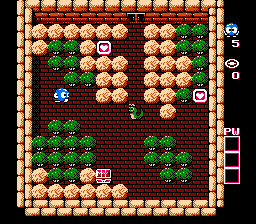
Today’s project involved transitioning from a passthrough codec to one that does some minimal amount of coding. This version determines the number of unique colors that a frame uses, codes the palette, and codes the palette indices using the minimum number of of bits necessary. For example, if there are 16 unique colors, only 4 bits are needed to code each pixel. If there are 18 colors, 5 bits are needed. Both of these are common situations for my basic test case:


The Adventure Of Lolo
The Adventures of Lolo, NES

According to my AVI frame-tallying tool:

Assuming 60 frames/sec:
  952 video frames, 0m15s running time, 30263114 total video bytes
  2017540 avg video bytes/sec, 31788 avg video bytes/frame
  min video frame = 5 bytes, max video frame = 35905 bytes

This compression scheme is all keyframes so far. While 30 MB is better than 218 MB, which is the original size of the movie, this is far from an optimal coding. The best compression at this point comes from single-color frames. The next phase is to try some different compression techniques and see which one yields the best nominal result.

Intel Syntax Using ‘objdump’

At first I was planning to conduct a survey of binary disassemblers just to find one that could disassemble a Linux ELF binary and show the machine instructions in Intel format instead of AT&T format. However, a little man page perusal revealed that the standard objdump utility– part of the GNU binutils suite– knows how to disassemble into this syntax. For the curious, the extra command line parameter that will do this is ‘-M intel’. There it is! No more ugly AT&T ASM syntax.

Just a little FYI.