I was giddy when I recently learned that there were x86_64 builds of the Real codecs available that had function names inside, if for no other reason than that it might finally provide a good reason to learn x86_64 ASM. But then Benjamin helpfully pointed out that there are .a libraries available for their codecs as well (look for .a files in the current source packages). These are far more interesting, particularly in the context of black box reverse engineering. So I established a little proof of concept experiment.
Author Archives: Multimedia Mike
V.Disc
So I went out and got one of those V.Discs that operate with the VTech V.Flash console: The Amazing Spider-Man: Countdown To Doom. This is what it looks like, front and back (click for larger pictures):


The door in the back is spring-loaded; I taped it open for the photo shoot. Now I just need a good way to get the cartridge open, hopefully by employing a method somewhat more sophisticated than my first impulse– bang with rock. I’m not really worried about getting the disc back into the cartridge. But it would be nice to ensure that the optical disc is not damaged during the process. Even if I get a cheap V.Flash console somewhere down the line, it stands to reason that the disc can be placed in the audio CD tray and played. Though there could be some mechanism to prevent that– perhaps the cartridge design trips some switch in the console authorizing the disc as an actual bootable game. The game’s instruction manual warns of the legal ramifications of copying and claims that backup or archival copies are legally prohibited. So, the manual tacitly acknowledges that copying is somehow possible.
Studying the remainder of the manual as well as the box copy, I see no other companies involved other than VTech (and the myriad license holders of the properties advertised). So I imagine that VTech develops all the software in-house.
As an aside, when it comes to children’s toys, I have really been out of it for the last, oh, 17 years or so. When wandering down the toy aisle containing the VTech products, I was stunned by the volume of tech-y kids toys. I guess it’s a good business model– sell some kind of cheap base system and then sell lots of media. And I don’t know what I was thinking in my previous post when I expressed amazement at VTech’s licensee lineup for the V.Flash– these companies will whore their properties to just about anyone, as my trip to the toy aisle revealed (e.g., Disney for every no-name gizmo system). But as long as a system uses optical media and probably displays FMV, you know I’ll be interested.
Obligatory MultimediaWiki page: It’s not much more impressive than the current English Wikipedia page.
V.Flash
I briefly spied a television commercial for a product called the V.Flash by VTech. The sound was off, but I got the impression that it was some kind of new game console for young children. And it appeared to have pretty decent graphical capabilities which is somewhat unexpected in this market.
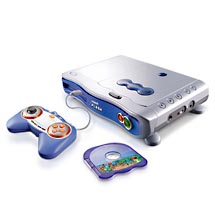
Based on Google searches thus far, there doesn’t seem to be a big underground/hacking/homebrew scene developing around this new console yet. So it’s difficult to find hard technical data about it. Whatever the guts are made of, it must be possible to sell them at US$100 per unit and presumably make a profit. The 3D graphics aren’t especially revolutionary, but who can tell the difference in this day and age? In fact, based on screenshots and web videos I have seen thus far, the graphic quality strikes me as reminiscent of the PlayStation-N64 days. Further, the unit only supports composite A/V output.
Here is the PDF manual for the V.Flash console. As you can see from the above marketing photo, the system uses optical media in a cartridge, which is affectionately termed a V.DiscTM. The manual describes that the console comes with a tray onto which a user can mount an audio CD (and apparently a photo CD). This implies that the unit has the optical hardware to read CDs. I think it’s reasonable that it does not also read DVDs or else they would probably be able to advertise DVD playback capability. Plus, DVD playback ability would markedly increase costs via parts and technology licensing costs.
Naturally, I’m interested to see if the CDs have any FMV. The games are apparently widespread wherever fine toys are sold. They are around US$30 each and the company has managed to publish an impressive line-up of licensed titles featuring such properties as Spider-Man, Spongebob Squarepants, and Disney Princesses. It seems reasonable that one of these discs could be separated from its cartridge relatively easily and read in a normal PC’s optical drive.
What’s the wager that the unit contains, at its heart, an x86_32-type CPU? Then again, the V.Flash comes from a company that is hardly a startup and appears to have years of experience making small, game-related devices.
Those Who Can, Do
The conventional adage has held that “Those who can, do; those who can’t, teach.” I’ve recently observed some alternative vocations for those who can’t. For example, “Those who can, do; those who can’t, carry out sociological studies on those who can in some effort to gain insight into what motivates them to do what they do.” Not especially catchy, but there it is.
If you participate in any open source software development, or even just hang out on development mailing lists, you have probably seen emails from university grad students performing some survey of open source developers. I’ve been doing this free software programming stuff since 1999. I don’t remember exactly when I first saw one of these email solicitations to fill out a survey but I do remember that I thought it novel at the time and cheerfully contributed. Same with the next half dozen or so. Eventually, I started getting that “haven’t I seen this before?” feeling when encountering such survey solicitations. This notion is exacerbated by the fact that each survey seems to think that it’s breaking new ground.
The only reason I bring this up is that I got another survey solicitation today in private email. This email was particularly irksome in that it was actually a followup to an earlier solicitation that demanded to know why I had not responded to the earlier inquiry.
As I compose this post, it suddenly occurs to me to wonder why anyone would care about collating this type of data (aside from a researcher attempting to justify his academic existence and delaying the real world activities as long as possible). This latest survey comes from people in some business and management schools. I can’t shake the feeling that there might be some businesses out there who would be interested to know what motivates open source software development in an effort to better leverage the model for their own business objectives.