Breaking Eggs And Making Omelettes

Topics On Multimedia Technology and Reverse Engineering


Archives:

Long Overdue MediaWiki Upgrade

February 4th, 2014 by Multimedia Mike

What do I do? What I do? This library book is 42 years overdue!
I admit that it’s mine, yet I can’t pay the fine,
Should I turn it in or should I hide it again?
What do I do? What do I do?

I internalized the forgoing paean to the perils of procrastination by Shel Silverstein in my formative years. It’s probably why I’ve never paid a single cent in late fees in my entire life.

However, I have been woefully negligent as the steward of the MediaWiki software that drives the world famous MultimediaWiki, the internet’s central repository of obscure technical knowledge related to multimedia. It is currently running of version 1.6 software. The latest version is 1.22.

The Story So Far
According to my records, I first set up the wiki late in 2005. I don’t know which MediaWiki release I was using at the time. I probably conducted a few upgrades in the early days, but that went by the wayside perhaps in 2007. My web host stopped allowing shell access and the MediaWiki upgrade process pretty much requires running a PHP script from a command line. Upgrade time came around and I put off the project. Weeks turned into months turned into years until, according to some notes, the wiki abruptly stopped working in July, 2011. Suddenly, there were PHP errors about “Namespace” being a reserved word.

While I finally laid out a plan to upgrade the wiki after all these years, I eventually found that the problem had been caused when my webhost upgraded from PHP 5.2 -> 5.3. I also learned of a small number of code changes that caused the problem to go away, thus kicking the can down the road once more.

Then a new problem showed up last week. I think it might be related to a new version of PHP again. This time, a few other things on my site broke, and I learned that my webhost now allows me to select a PHP version to use (with the version then set to “auto”, which didn’t yield much information). Rolling back to an earlier version of PHP might have solved the problem easily.

But NO! I made the determination that this goes no further. I want this wiki upgraded.

The Arduous Upgrade Path
There are 2 general upgrade paths I can think of:
Read the rest of this entry »

Posted in General | 4 Comments »

Chrome’s New Audio Notifier

January 29th, 2014 by Multimedia Mike

Version 32 of Google’s Chrome web browser introduced this nifty feature:


Chrome audio notifier icon

When a browser tab has an element that is producing audio, the browser’s tab shows the above audio notification icon to inform the user. I have seen that people have a few questions about this, specifically:

  1. How does this feature work?
  2. Why wasn’t this done sooner?
  3. Are other browsers going to follow suit?

Short answers: 1) Chrome offers a new plugin API that the Flash Player is now using, as are Chrome’s internal media playing facilities; 2) this feature was contingent on the new plugin infrastructure mentioned in the previous answer; 3) other browsers would require the same infrastructure support.

Longer answers follow…

Plugin History
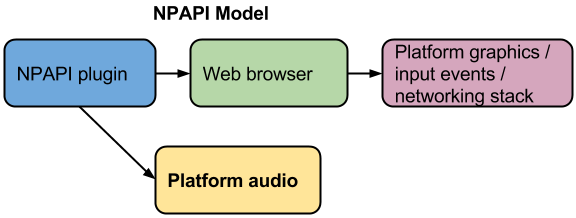
Plugins were originally based on the Netscape Plugin API. This was developed in the early 1990s in order to support embedding PDFs into the Netscape web browser. The NPAPI does things like providing graphics contexts for drawing and input processing, and mediate network requests through the browser’s network facilities.

What NPAPI doesn’t do is handle audio. In the early-mid 1990s, audio support was not a widespread consideration in the consumer PC arena. Due to the lack of audio API support, if a plugin wanted to play audio, it had to go outside of the plugin framework.


NPAPI plugin model

There are a few downsides to this approach:

So that last item hopefully answers the question of why it has been so difficult for NPAPI-supporting browsers to implement what seems like it would be simple functionality, like implementing a per-tab audio notifier.

Plugin Future
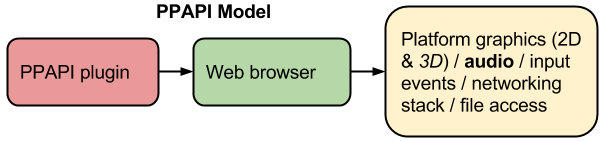
Since Google released Chrome in an effort to facilitate advancements on the client side of the internet, they have made numerous efforts to modernize various legacy aspects of web technology. These efforts include the SPDY protocol, Native Client, WebM/WebP, and something call the Pepper Plugin API (PPAPI). This is a more modern take on the classic plugin architecture to supplant the aging NPAPI:


PPAPI plugin model

Right away, we see that the job of the plugin writer is greatly simplified. Where was this API years ago when I was writing my API jungle piece?

The Linux version of Chrome was apparently the first version that packaged the Pepper version of the Flash Player (doing so fixed an obnoxious bug in the Linux Flash Player interaction with GTK). Now, it looks like Windows and Mac have followed suit. Digging into the Chrome directory on a Windows 7 installation:

AppData\Local\Google\Chrome\Application\[version]\PepperFlash\pepflashplayer.dll

This directory exists for version 31 as well, which is still hanging around my system.

So, to re-iterate: Chrome has a new plugin API that plugins use to access the audio API. Chrome knows when the API is accessed and that allows the browser to display the audio notifier on a tab.

Other Browsers
What about other browsers? “Mozilla is not interested in or working on Pepper at this time. See the Chrome Pepper pages.”

Posted in General | 6 Comments »

Next Entries »